
Fabric Swan Appliqué Pattern is a beautiful way to transform small pieces of fabric into an elegant decorative project inspired by the graceful shape of a swan. The design shown in the reference image is especially attractive because the body and long curved neck are created from many overlapping, feather-shaped fabric pieces.
Instead of relying on one large piece of fabric, this technique combines floral prints, gingham, polka dots, solids, and botanical patterns to produce texture and movement. The combination of pink, cream, white, and green gives the swan a romantic handmade appearance, but the same method can easily be adapted to another color palette. This project is also an excellent opportunity to use treasured fabric scraps that may be too small for traditional sewing projects.
The construction of this Fabric Swan Appliqué Pattern is based on layering rather than complicated piecing. Individual elongated fabric shapes act as feathers and are positioned in overlapping rows until they create the recognizable silhouette of the bird. The swan’s neck curves upward from the body, while longer feather pieces extend toward the tail to create a flowing appearance. A small contrasting head and beak complete the design and provide a strong focal point. Although the finished appliqué looks detailed, the individual components are simple enough to trace, cut, arrange, and attach one at a time. This makes the project approachable for confident beginners while still offering experienced sewists plenty of opportunities for creative fabric placement and embellishment.
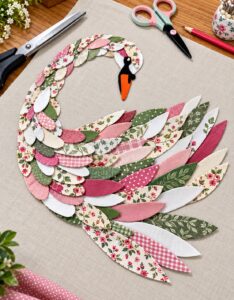
One of the most important parts of making a successful fabric swan appliqué is preparing the complete composition before permanently attaching anything. Think of the process as creating a fabric collage: the outline establishes the basic shape, the larger pieces create structure, and the smaller overlapping feathers fill the remaining spaces. Careful planning helps maintain the swan’s smooth curves while preventing unwanted gaps between pieces. The finished motif can become a wall hanging, quilt center, decorative pillow panel, tote bag feature, framed textile artwork, or part of a larger quilt. The following tutorial explains the materials, templates, arrangement, appliqué techniques, and finishing steps needed to recreate a project inspired by the photograph.
Materials and Templates for the Fabric Swan Appliqué Pattern
Begin by selecting fabrics for your Fabric Swan Appliqué Pattern. A coordinated collection works especially well because the project contains many separate pieces. For an appearance similar to the reference design, choose approximately six to ten fabrics in soft pink, green, cream, and white. Combine small floral prints with gingham, dots, leaves, and a few solid fabrics. Cotton quilting fabric is an excellent choice because it is easy to cut accurately and remains relatively stable while being handled.
You will also need a background fabric large enough to accommodate the complete swan. A neutral cotton or cotton-linen blend provides good contrast without competing with the patterned feathers. For a medium decorative panel, consider beginning with a background approximately 50 x 60 cm, leaving generous space around the appliqué for trimming and finishing. The exact dimensions can be adjusted according to the final use of the project.
The primary template is an elongated feather or leaf shape with pointed ends. Prepare several sizes rather than making every feather identical. Small pieces of approximately 6–8 cm long, medium pieces around 9–12 cm, and larger tail feathers measuring approximately 13–17 cm create a natural transition across the body. Widths can range from roughly 2.5–5 cm, depending on the length. These measurements are flexible because this is a decorative appliqué rather than a precision patchwork block.
For the neck, use smaller and narrower feather shapes so they can follow the curved silhouette smoothly. The outer edge of the neck should create a graceful arc, beginning near the body and narrowing gradually toward the head. Before cutting fabric, sketch a simple swan outline on paper. A finished motif measuring roughly 40–45 cm wide can work nicely on the suggested background, although you can enlarge or reduce the entire design according to your project.
Additional supplies include fabric scissors, paper scissors, a fabric marking pencil, pins or appliqué glue, an iron, coordinating thread, and a sewing machine if you plan to stitch the pieces mechanically. Fusible web is optional but extremely helpful for beginners because it keeps the numerous feathers from shifting. If using fusible web, always follow the manufacturer’s instructions regarding iron temperature and pressing time.
The head and beak should contrast clearly with the decorative body. The reference project uses a dark head with a bright warm-colored beak, creating an easily recognizable swan profile. Cut the head and upper neck from black or another dark fabric or felt, then create a narrow orange beak. A tiny white detail can suggest the eye. Keep these elements simple because the layered feathers should remain the dominant feature of the Fabric Swan Appliqué Pattern.
Cutting and Arranging the Layered Fabric Feathers
Start the cutting stage by preparing more feathers than you expect to need. For a medium Fabric Swan Appliqué Pattern, approximately 60–90 feather pieces can provide enough variety for experimentation, depending on their size and how densely they overlap. Trace the templates onto the wrong side of your fabrics and distribute the different sizes among all your prints. Avoid cutting every large feather from one color because variety is what gives this design its lively patchwork appearance.
Cut each feather carefully along the traced line. Smooth curves are more important than absolute uniformity, so minor differences between pieces are perfectly acceptable. In fact, subtle variations help the finished swan look organic. If you are using raw-edge appliqué, make clean cuts with sharp scissors to minimize fraying. If you prefer turned-edge appliqué, remember to include an appropriate seam allowance around each template before cutting.
Place the background fabric on a large flat work surface and lightly mark the general swan silhouette. Do not draw every feather position. You mainly need guidelines for the lower body, upper wing, tail, neck, and head. Begin arranging pieces at the outer edge of the neck. Position each new feather so that it partially covers the previous piece, similar to overlapping roof shingles or natural bird plumage.
Continue the neck downward until it connects naturally with the body. Alternate cream, green, pink, floral, and white fabrics instead of placing several identical prints next to one another. This controlled variety is an important feature of the Fabric Swan Appliqué Pattern. Step away from the work occasionally and look at the complete silhouette. If one color appears too concentrated in a particular area, move a few pieces before attaching them.
Next, establish the outer body and tail. Place some of the longest feathers along the lower edge and toward the back of the swan. Their pointed ends should extend outward to create the sweeping tail visible in the inspiration image. Layer medium feathers above these pieces, changing their angles slightly. The direction of the feathers should visually lead from the rounded body toward the tail rather than appearing randomly scattered.
Finally, fill the center of the body with overlapping rows. Try to conceal most of the base of each feather beneath the next layer while allowing the pointed end to remain visible. This creates depth without requiring padding. Photographing the arrangement before removing pieces for pressing or sewing can be extremely useful. Once you are satisfied with the composition, you have effectively completed the most creative stage of the Fabric Swan Appliqué Pattern.
How to Attach and Sew the Fabric Swan Appliqué
When the arrangement is complete, begin securing the feathers systematically. If using fusible appliqué, work in manageable sections rather than attempting to lift the entire composition. Start with the pieces that sit underneath all other layers. Apply fusible web to the wrong side according to its instructions, replace the feather in its original position, and press it carefully. Continue from the lowest layer toward the uppermost pieces.
For a traditional raw-edge appliqué, each feather can be stitched close to its perimeter. A straight stitch approximately 2–3 mm from the raw edge provides a simple handmade appearance. A narrow zigzag or blanket stitch offers additional edge coverage and can become a decorative feature. Choose a neutral thread when you want the stitches to disappear visually, or use contrasting thread when you want the appliqué work to become part of the design.
Work slowly around pointed ends. When machine sewing, stop with the needle down near the point, lift the presser foot, rotate the fabric, lower the foot, and continue along the opposite side. This technique creates cleaner points and smoother curves. Because the Fabric Swan Appliqué Pattern contains many overlapping pieces, you do not necessarily need to stitch every concealed portion of every feather. Concentrate on securing the visible edges and any areas that might lift.
The body should be stitched from the bottom layers upward whenever possible. This sequence maintains the natural overlapping effect. The larger tail feathers require special attention because their pointed ends extend farther from the body and may be more likely to curl. Secure these pieces carefully while preserving their elongated shapes. Avoid excessive stitching that could flatten the entire design; some visual dimension contributes to the charm of the project.
After completing the body and neck, position the head over the upper end of the curved neck. Attach it using the same appliqué method. Add the contrasting beak and a small eye detail. Check the transition between the patterned neck and dark head carefully so the two sections appear connected rather than separate. A few discreet hand stitches can help refine small areas that are difficult to reach comfortably with a sewing machine.
Press the finished fabric appliqué gently from the wrong side whenever the materials allow it. Protect dimensional or delicate components by placing the project on a soft pressing surface. Inspect the complete swan for loose edges, visible background gaps, or pieces that need extra stitching. This final inspection is worthwhile because small adjustments at this stage can make the overall silhouette considerably cleaner and more professional.
Finishing, Customizing, and Displaying Your Swan Project
Once the appliqué is secure, decide how you want to use the finished Fabric Swan Appliqué Pattern. For wall art, add batting and backing behind the background fabric, then quilt around the silhouette to emphasize its shape. Echo quilting following the curve of the neck and body can make the swan stand out beautifully. Finish the outer edge with traditional quilt binding for a polished textile panel.
For a decorative pillow, center the completed appliqué on a front panel and trim the background to the desired cushion size. Add lightweight batting behind the front if you want additional structure. Quilt the background before constructing the pillow cover, then add an envelope or zipper closure. A swan made with soft floral fabrics can work especially well in bedrooms, sewing rooms, nurseries, or cottage-inspired interiors.
The pattern can also be personalized through color. A scrap fabric appliqué does not have to use pink and green. Blue, aqua, and white fabrics can produce a cool coastal interpretation, while burgundy, rust, gold, and olive can create an autumn version. For a more contemporary project, try black, white, gray, and one bright accent color. Maintaining a balanced distribution of light, medium, and dark fabrics is more important than following one exact palette.
Fabric scale is another useful design tool. Small floral prints are ideal for the narrow neck feathers because most of the motif remains visible within a small shape. Larger prints can be reserved for the broader body and tail pieces. Solids, gingham, dots, and subtle textures provide visual rest between detailed florals. This mixture prevents the Fabric Swan Appliqué Pattern from becoming overly busy while preserving its charming patchwork character.
Save the feather templates after completing the swan because the same basic shapes can be reused for other projects. They can become flower petals, leaves, wings, scales, or abstract layered motifs. Making templates from cardstock or thin reusable plastic will help them last longer. You can also create a labeled template set containing small, medium, large, and extra-long feathers so future projects can be prepared more quickly.
Before displaying or gifting the finished project, remove loose threads and check every appliqué edge. If the item will be washed regularly, secure raw edges more thoroughly than you would for framed wall art. Gentle laundering is preferable for heavily layered appliqué because repeated aggressive washing can encourage fraying. With thoughtful construction and appropriate care, this Fabric Swan Appliqué Pattern can become a distinctive handmade piece that celebrates both sewing creativity and leftover fabric.
FAQ – Frequently Asked Questions About the Fabric Swan Appliqué Pattern
Is the Fabric Swan Appliqué Pattern suitable for beginners?
Yes. The project looks intricate because it contains many feathers, but the individual shapes are straightforward. Beginners can simplify construction by using fusible web before stitching. The most important skill is arranging the pieces patiently so the overall swan silhouette remains recognizable.
What fabric works best for this project?
Quilting cotton is one of the easiest options because it cuts cleanly, presses well, and is available in many coordinated prints. Cotton-linen blends can work nicely for the background. Felt may also be useful for small details such as the head, eye, or beak.
How many fabric feathers will I need?
The exact number depends on the finished size and amount of overlap. A medium design may use roughly 60 to 90 pieces, but this is an approximate creative guideline rather than a fixed requirement. Preparing extra pieces gives you more freedom when balancing colors and filling small gaps.
Do all the feathers need to be the same size?
No. Using several sizes actually improves the design. Smaller feathers make it easier to form the curved neck, medium pieces fill the body, and longer shapes create the dramatic tail. Variation also gives the swan appliqué pattern a more natural sense of movement.
Can I make the appliqué without fusible web?
Absolutely. Pieces can be held temporarily with appliqué glue or pins and then stitched directly to the background. Traditional turned-edge appliqué is another option for sewists who prefer enclosed edges. Fusible web simply makes managing numerous overlapping pieces easier.
Should I sew every feather separately?
It depends on the intended use. For a frequently handled or washable item, secure the exposed edges carefully. For framed textile art, less stitching may be sufficient if the pieces have been properly fused. Always make sure extended tail pieces and other exposed areas are firmly attached.
Can I use fabric scraps from other projects?
Yes, and this is one of the strongest reasons to try the project. Small leftover pieces from quilts, bags, and sewing projects can become individual feathers. Coordinating scraps by color or value can turn an assorted collection into a cohesive fabric scrap project.
How can I enlarge or reduce the swan?
Scale the basic silhouette and feather templates proportionally. A larger swan will generally benefit from larger and more numerous feathers, while a miniature version requires narrower pieces that can follow tighter curves. Arrange everything temporarily before sewing to confirm that the proportions work.
How do I prevent the design from looking too crowded?
Distribute strong colors throughout the body rather than clustering them in one place. Mix patterned pieces with solids or low-volume fabrics. Leaving enough of each pointed feather visible also helps individual shapes remain distinct even when the layers overlap heavily.
What can I make with the finished Fabric Swan Appliqué Pattern?
The motif can become the centerpiece of a wall hanging, quilt, pillow, tote bag, decorative panel, framed textile artwork, or other handmade sewing project. Choose the finishing method according to how often the finished item will be handled or washed.
Conclusion
The Fabric Swan Appliqué Pattern turns a collection of simple fabric shapes into an impressive layered textile design. The process begins with selecting coordinated fabric scraps, preparing feather templates in several sizes, and sketching the graceful swan silhouette. By placing smaller feathers around the curved neck, medium pieces throughout the body, and longer pieces toward the tail, you can gradually build the flowing appearance that makes this project so distinctive.
The most important lesson is to arrange the entire composition carefully before committing to permanent stitching. Balanced colors, varied prints, consistent overlap, and well-directed feathers create movement while preserving the recognizable shape of the swan. Fusible web can simplify assembly, while straight stitch, zigzag stitch, blanket stitch, or traditional appliqué techniques allow the sewing method to be adapted to your experience and preferred finish.
Once completed, this Fabric Swan Appliqué Pattern can be customized in countless ways through fabric selection, scale, stitching, quilting, and final presentation. It is also a practical way to transform leftover cotton pieces into something decorative instead of allowing useful scraps to remain forgotten in the sewing basket. Whether you choose romantic florals like those in the inspiration image or create an entirely different palette, the same layered technique can produce a unique result.
If you make your own version, leave your sincere opinion about the project and share your suggestions for future patterns or tutorials. Your ideas about colors, fabrics, finishing methods, and creative variations can inspire new ways to use this beautiful Fabric Swan Appliqué Pattern.